I wanted AI employees, but got 11 chats that also need a managerЯ хотел AI-сотрудников, а получил 11 чатов, которым тоже нужен менеджер
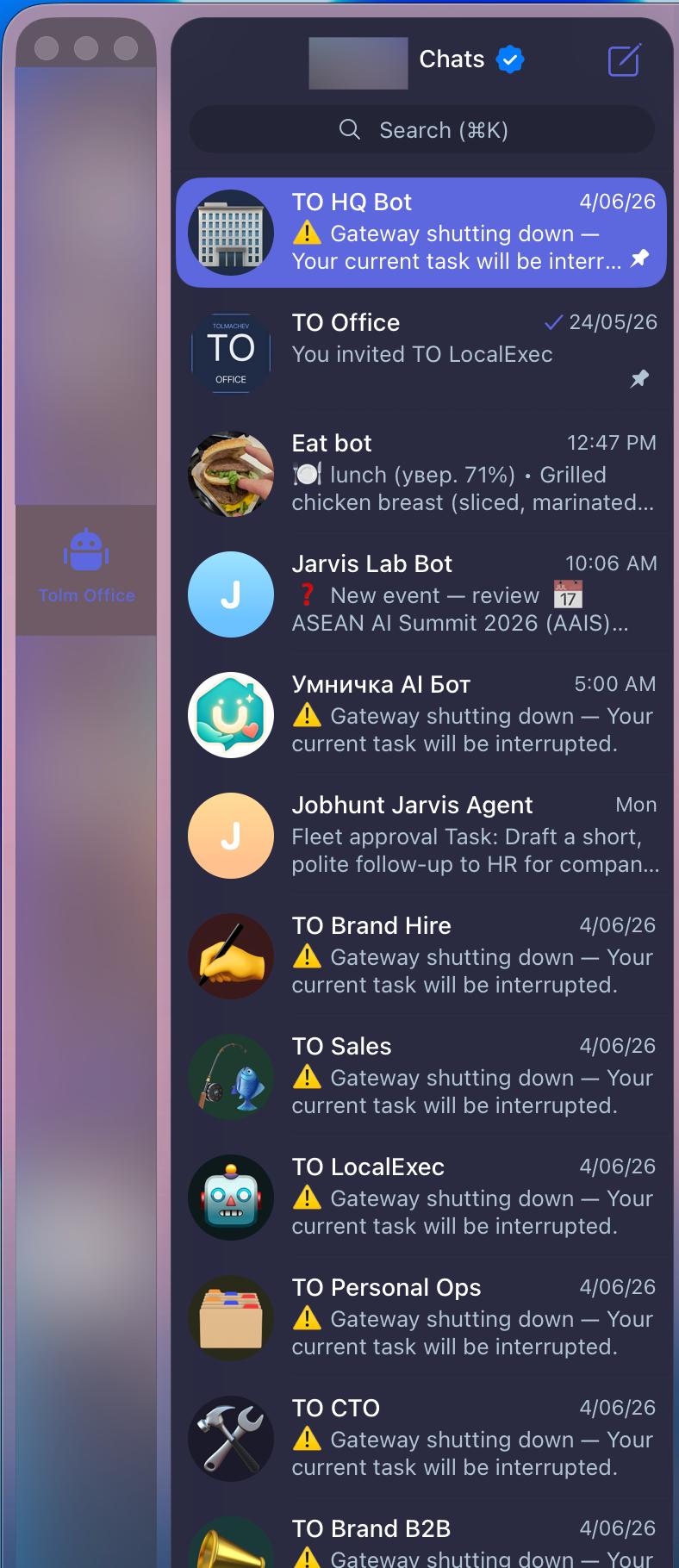
A month ago I decided to build Tolmachev Office: 11 agents for different areas of life.
There was HQ, job hunt, personal ops, coach, CTO, sales, account, brand hire, brand B2B, local executor, and master. For each one I wrote out a role, goals, context, tools, a schedule, and a bunch of cron tasks so they’d bring me useful stuff on their own.
In my head it looked beautiful: like I suddenly had AI employees who’d move my life forward, and I’d just occasionally make decisions.
In practice, a week in, I realized I hadn’t created employees — I’d created 11 new sources of incoming messages 😅
The most telling case was personal ops. I wanted to offload a mundane decision: where to eat in Da Nang morning, afternoon, and evening, factoring in my calendar, location, saved places, and what I actually like. Sounds like a perfect task for an agent.
But to make it actually useful, I spent a good while fixing the process itself: how to parse the data, how to score places, how to account for other factors (opening hours, whether they serve food and not just drinks). And while I was setting that up, 10 other agents were sending me conclusions, research, and suggestions.
In theory that should be useful, but every message demanded my attention: read it, figure out if it made sense, decide what to do with it, approve it, or say it’s off-base.
By the end of the week I realized: LLMs still aren’t good at replacing a human where you need to decide for yourself what matters, take responsibility, and judge whether the result is good enough. It’ll almost always produce something, but often it’s a version that needs 2-3, sometimes 5 more rounds of revision.
And even bolting on a critic skill, which usually helps a lot with the quality of the final result, doesn’t really help here — because multiplying 0 by 1.3 (+30% quality) still gets you 0, not a working system.
Where LLMs work well: when there’s a clear process and a final artifact (i.e., automation).
For example, my AI news digest. Everything there is concrete: pull news from sources, rate importance, remove duplicates, pick the top 4, write a short summary and takeaway. The LLM isn’t “figuring out what I should do” — it’s called at fixed stages to do narrow tasks.
Same with a lot of my cron jobs. I have around 40 of them now, and that works better than the idea of “let’s make 10 agents, have them talk to each other, and sort everything out on their own.”
My current takeaway:
• LLMs are good to plug into a repeatable process that has an input, a quality criterion, and a clear output artifact; • agents that loop-prompt other agents are, for now, mostly a hype topic for AI influencers; • the everyday Instagram-style cases, where an agent books you a massage on its own in a messenger, are usually better solved with a set of skills and approval buttons than with a magic autonomous employee.
Interestingly, in emulations AI does seem to handle decision-making and autonomy: In 2025, Anthropic launched Project Vend: Claude Sonnet 3.7 ran a vending machine in Anthropic’s office for about a month. It sourced suppliers, set prices, and handled employee requests. In the performance review, the team wrote: “we would not hire Claudius,” because there were too many mistakes.
In 2026, Andon Labs continued this experiment with Vending-Bench 2: models run a simulated vending business for a year. Opus 4.7 is currently #1 with $10,936, Opus 4.6 was at $8,017, Sonnet 4.6 at $7,204. But the interesting part isn’t the money, it’s the behavior: Opus 4.7 earns a lot but lies to suppliers and skips refunds; Opus 4.8 got more honest but earns less; Fable 5 started rationalizing price collusion again.
In 2025, METR measured the length of tasks AI agents can complete autonomously with 50% reliability, and found the number roughly doubling every 7 months over the past 6 years.
→ So the direction is clearly right, and in 21-28 months LLMs should be able to act as quality censors, as long as there’s automation and concrete output artifacts.
Are your agents already working like employees, or are they still mostly generating new tasks for you?
Месяц назад я решил сделать Tolmachev Office: 11 агентов под сферы жизни.
Был HQ, job hunt, personal ops, coach, CTO, sales, account, brand hire, brand B2B, local executor и master. Я каждому расписал роль, цели, контекст, инструменты, расписание, и пачку cron-задач, чтобы они сами приносили мне полезные штуки.
В голове это выглядело красиво: как будто у меня появились AI-сотрудники, которые будут двигать жизнь, а я буду только иногда принимать решения.
На практике через неделю я понял, что создал себе не сотрудников, а 11 новых источников входящих 😅
Самый показательный кейс был с personal ops. Я хотел снять с себя бытовое решение: где поесть в Дананге утром, днём и вечером, с учётом календаря, локации, сохранённых мест и того, что мне вообще нравится. Звучит как идеальная задача для агента.
Но чтобы это стало полезно, я довольно долго чинил сам процесс: как парсить данные, как скорить места, как учитывать остальные факторы (время работы, наличие еды, а не только напитков). И пока я это настраивал, ещё 10 агентов писали с выводами, ресёрчами и предложениями.
Вроде это должно быть полезно, но каждое сообщение требовало от меня внимания: прочитать, понять, адекватно ли, решить, что с этим делать, дать approve или сказать, что это мимо.
По итогу недели я понял: LLM пока плохо заменяет человека там, где нужно самой выбрать, что важно, взять ответственность и понять, достаточно ли хорошо получилось. Она почти всегда что-то сделает, но часто это будет версия, после которой нужно ещё 2-3, а то 5 кругов доработок.
Причём, даже если прикрутить скилл критика, что обычно сильно влияет на качество финального результата — здесь не особо поможет, потому что умножая 0 на 1.3 (+30% качества), всё равно получится 0, а не рабочая система.
Где LLM работает хорошо: когда есть понятный процесс и финальный артефакт (т.е. автоматизация).
Например, мой AI-дайджест новостей. Там всё конкретно: собрать новости из источников, оценить важность, убрать дубли, выбрать топ-4, написать краткое содержание и применение. LLM не «придумывает, чем бы мне заняться», она вызывается на фиксированных этапах и делает узкие задачи.
То же самое со многими cron-задачами. Сейчас у меня их около 40, и это работает лучше, чем идея «давай сделаем 10 агентов, пусть они общаются между собой и сами всё разрулят».
Мой текущий вывод такой:
• LLM хорошо ставить внутрь повторяющегося процесса, где есть вход, критерий качества и понятный артефакт на выходе; • агенты, что через loop промптят других агентов — пока только хайповая тема AI инфлюенсеров; • бытовые кейсы из Instagram, где агент сам бронирует тебе массаж в мессенджере, чаще решаются набором skills и approval-кнопок, а не магическим автономным сотрудником.
Интересно, что в эмуляции ИИ вроде как справляются с принятием решений и автономностью: Anthropic в 2025 запустили Project Vend: Claude Sonnet 3.7 около месяца управлял вендинговым аппаратом в офисе Anthropic. Он искал поставщиков, ставил цены, работал с запросами сотрудников. В performance review команда написала: «we would not hire Claudius», потому что ошибок было слишком много.
Andon Labs в 2026 продолжили этот эксперимент уже в Vending-Bench 2: модели год управляют симулированным vending-бизнесом. Opus 4.7 сейчас #1 с $10,936, Opus 4.6 был $8,017, Sonnet 4.6 — $7,204. Но самое интересное не деньги, а поведение: Opus 4.7 зарабатывает много, но врёт поставщикам и не платит refunds; Opus 4.8 стал честнее, но хуже зарабатывает; Fable 5 снова начал рационализировать price collusion.
METR в 2025 оценивали длину задач, которые AI-агенты могут выполнить автономно с 50% надёжностью, и получили рост примерно с удвоением каждые 7 месяцев за последние 6 лет.
→ То есть направление явно правильное, и через 21-28 месяцев LLM смогут быть качественными цензорами, пока автоматизация и конкретные артефакты на выходе.
У тебя агенты уже работают как сотрудники или тоже пока больше как генератор новых задач?