DLSS 5.0 on RTX 5070 TiDLSS 5.0 на RTX 5070 Ti
A few days ago, DLSS 5 (Neural Reconstruction) libraries leaked online from an early NBA 2K27 build, and modders immediately rolled them out across dozens of games—from DirectX 9 classics to modern titles.
Today, September 3, NVIDIA is officially releasing the technology. I spent several days testing it on my RTX 5070 Ti in The Witcher 3, Kingdom Come: Deliverance II, Cyberpunk 2077, and even some old childhood games. Here are my real-world takeaways and tests.
🧠 The big shift: not upscaling, but generating details on the fly
DLSS used to focus on scaling and anti-aliasing. With DLSS 5, the graphics card works like a neural-network artist in real time.
It reads the scene geometry and actually fills in missing microdetails: the texture of Geralt’s clothes and chainmail, individual blades of grass in the distance, castle brickwork, and pores on skin.
The settings include three model presets (A, B, and C) and an intensity slider from 0 to 1.0, letting you control how much the system “imagines” the image.
📉 FPS drops by half—and Frame Gen comes to the rescue
Generating details in real time is extremely demanding. The main catch with the first version is that enabling DLSS 5.0 cuts the frame rate roughly in half on average.
But there’s an elegant solution: • If your game runs at a stable 60 FPS ➔ enable DLSS 5.0 ➔ FPS drops to around 30. • Then enable Frame Generation 2x (or 3x) ➔ the counter returns to 60+ FPS, now with incredible neural-network detail and smooth visuals.
For owners of previous-generation cards (RTX 30/40), an OptiScaler mod is already available. It lets you lower the base rendering resolution to increase the frame rate, while DLSS 5 restores clarity by generating details without turning everything into a blurry mess.
⚔️ Real comparisons: Left—WITHOUT DLSS 5, Right—WITH DLSS 5
I put together clear center-frame crop comparisons from three games:
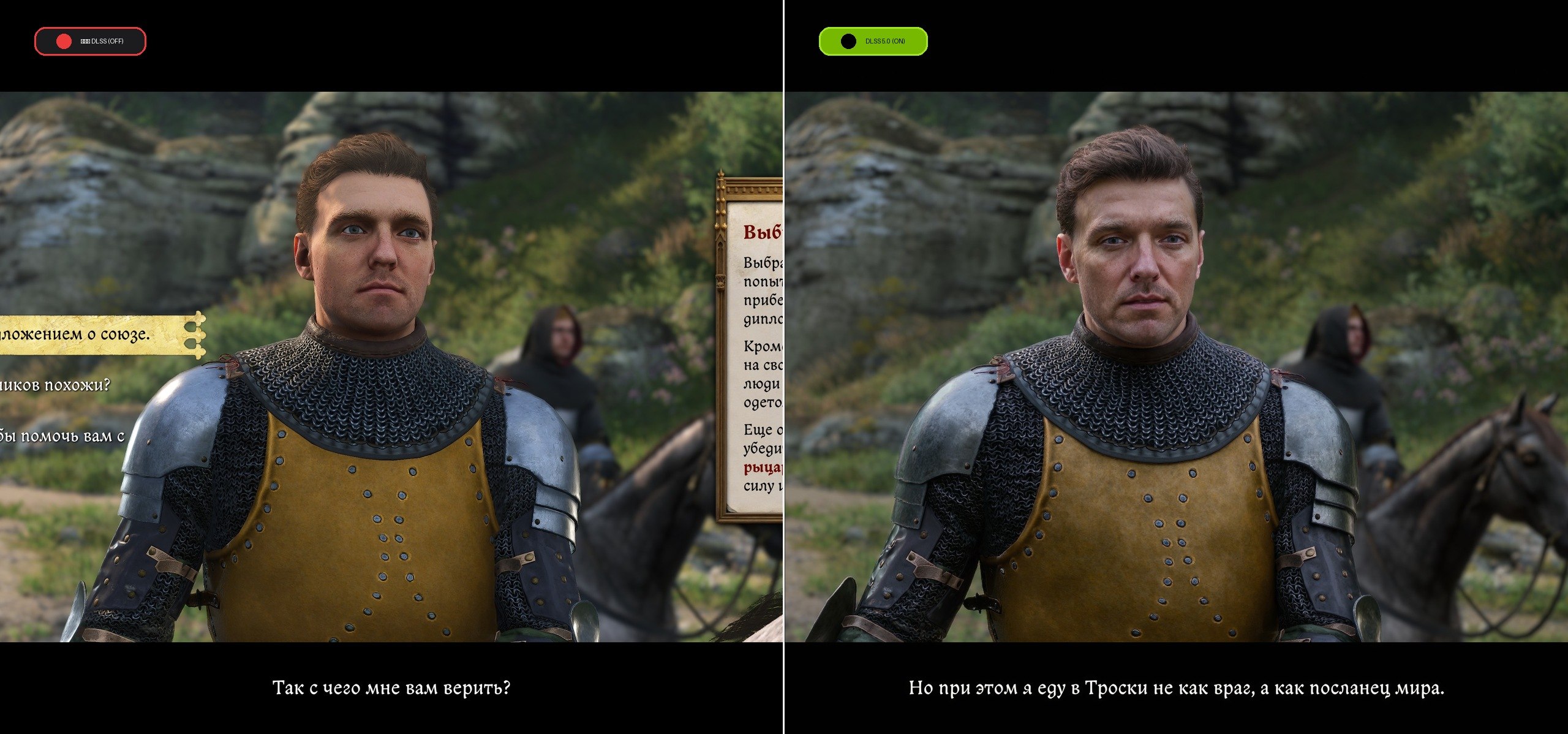
- Kingdom Come: Deliverance II: the detail in medieval clothing, dirt, armor, and vegetation increases dramatically.
- The Witcher 3: the game is already over 10 years old, but the neural network pulls astonishing material depth and distant detail out of its textures.
- Cyberpunk 2077: neon reflections, tiny text, and Night City’s geometry become extremely sharp.
Kingdom Come: Deliverance II: Left—WITHOUT DLSS 5.0 / Right—WITH DLSS 5.0
The Witcher 3: Left—WITHOUT DLSS 5.0 / Right—WITH DLSS 5.0
Cyberpunk 2077: Left—WITHOUT DLSS 5.0 / Right—WITH DLSS 5.0
😅 Artifacts and the limits of retro games
Where the technology still stumbles: • The “40-year-old child” effect: at high intensity, the neural network still doesn’t understand children’s ages and starts drawing adult wrinkles on their faces. Lowering the intensity to 0.3–0.5 fixes it. • Retro games: the effect is stunning in titles from 10–15 years ago (GTA 4, RDR2, The Witcher). But with games from 20–25 years ago—I even tried the old Madagascar game—there’s no miracle: the polygon mesh is so flat that the neural network simply has nothing to work with.
💡 What this means for the industry
In 2–3 years, we’ll stop downloading 150GB packs of 8K textures. Games will be smaller and contain basic geometry, while the graphics card generates all the photorealistic detail in real time for your screen.
На днях в сеть утекли библиотеки DLSS 5 (Neural Reconstruction) из раннего билда NBA 2K27, и моддеры тут же раскатали их на десятки игр — от DirectX 9 до современных тайтлов.
Сегодня, 3 сентября, NVIDIA выпускает технологию официально. Я несколько дней гонял её на своей RTX 5070 Ti в Ведьмаке 3, Kingdom Come: Deliverance II, Cyberpunk 2077 и даже старых играх из детства. Делюсь живыми выводами и тестами.
🧠 Главный сдвиг: не апскейл, а генерация деталей на лету
Если раньше DLSS занимался масштабированием и сглаживанием, то в DLSS 5 видеокарта работает как нейросеть-художник в реальном времени.
Она считывает геометрию сцены и физически дорисовывает недостающие микродетали: фактуру ткани и кольчуги у Геральта, отдельные травинки вдали, кирпичную кладку замков и поры на коже.
В настройках доступны 3 модели-пресета (A, B, C) и ползунок интенсивности от 0 до 1.0, чтобы регулировать степень «додумывания» картинки.
📉 Просадка FPS в 2 раза и формула спасения через Frame Gen
Генерация деталей в реальном времени очень тяжёлая. Главный нюанс первой версии — после включения DLSS 5.0 фреймрейт падает в среднем в 2 раза.
Но решается это элегантной связкой: • Если в игре у вас стабильные 60 FPS ➔ включаете DLSS 5.0 ➔ FPS падает до ~30 кадров. • В этот момент включаете Frame Generation 2x (или 3x) ➔ счётчик снова возвращается к 60+ FPS, но уже с невероятной нейросетевой детализацией и плавной картинкой.
Для владельцев карт прошлых поколений (RTX 30/40) уже вышла модификация с OptiScaler: она позволяет снизить базовое разрешение рендера и поднять фреймрейт, а DLSS 5 компенсирует чёткость генерацией деталей без мыла.
⚔️ Живые сравнения: Слева — БЕЗ DLSS 5, Справа — С DLSS 5
Собрал наглядные кроп-сравнения по центру кадра в трёх играх:
- Kingdom Come: Deliverance II: детализация средневековой одежды, грязи, доспехов и растительности возрастает колоссально.
- Ведьмак 3: игре уже 10+ лет, но нейросеть вытягивает из текстур потрясающую глубину материалов и дальних планов.
- Cyberpunk 2077: неоновые отражения, мелкие надписи и геометрия Найт-Сити становятся предельно резкими.
Kingdom Come: Deliverance II: Слева — БЕЗ DLSS 5.0 / Справа — С DLSS 5.0
The Witcher 3: Слева — БЕЗ DLSS 5.0 / Справа — С DLSS 5.0
Cyberpunk 2077: Слева — БЕЗ DLSS 5.0 / Справа — С DLSS 5.0
😅 Артефакты и предел возможностей в ретро-играх
Где технология пока спотыкается: • «Эффект 40-летнего ребёнка»: на высокой интенсивности нейросеть пока не понимает возраст детей и начинает рисовать им взрослые морщины на лицах. Лечится снижением интенсивности до 0.3–0.5. • Ретро-игры: в тайтлах 10–15-летней давности (GTA 4, RDR2, Ведьмак) эффект потрясающий. Но если взять игру 20–25-летней давности — я запускал даже старый «Мадагаскар» — чуда не происходит: полигональная сетка настолько плоская, что нейросети просто не за что зацепиться.
💡 Что это значит для индустрии
Через 2–3 года мы перестанем качать 150-гигабайтные пакеты 8K-текстур. Игры будут весить мало, содержать базовую геометрию, а всю фотореалистичную детализацию видеокарта будет генерировать прямо во время игры под ваш экран.