$100 on Codex vs. $100 on Claude$100 на Codex против $100 на Claude
A month of work, 40+ automations, and my final setup
Over the past month, I ran an experiment: I moved all my automations and my work with Claude (Opus 4.8) to Codex (GPT-5.5 → Sol 5.6).
Migration in a few hours
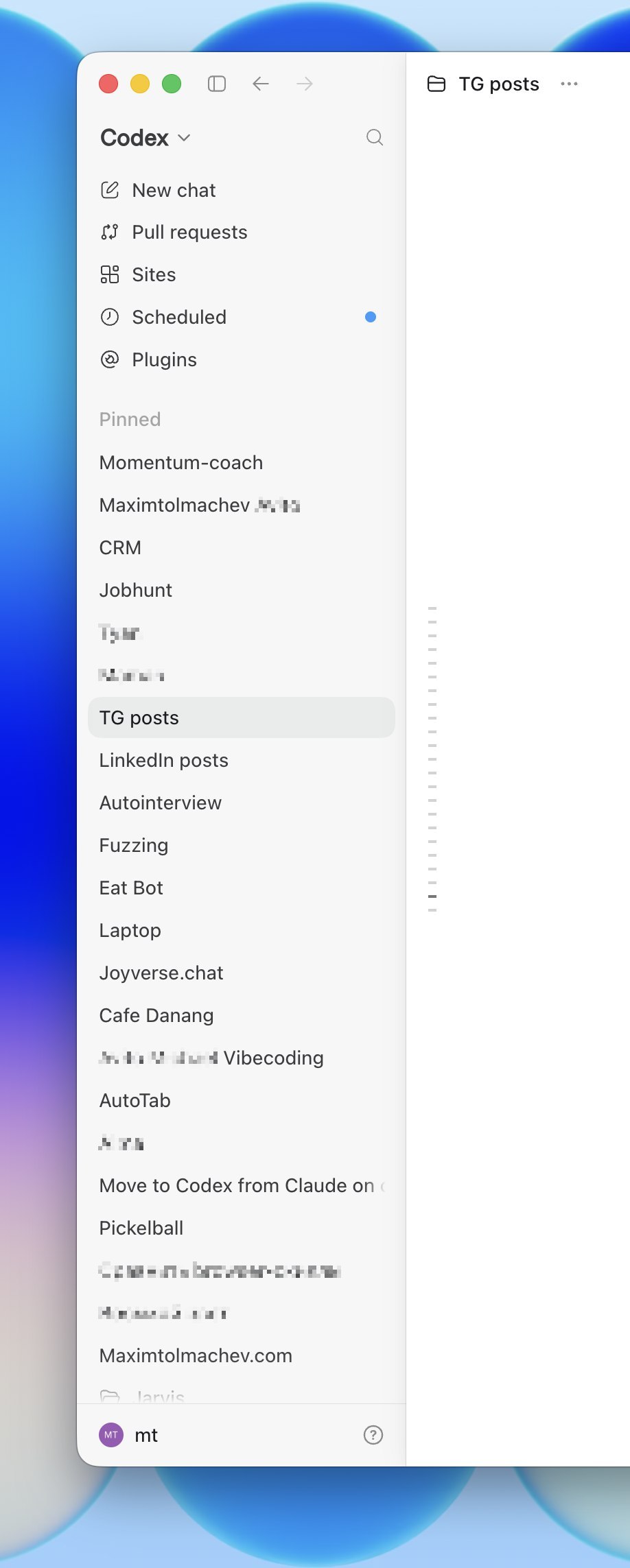
I did it in literally a few hours, despite having 10 separate projects and 22 ongoing chats. The switch may have been easy partly because of shared memory, shared skills, and a shared conversation database in Retain.
22 ongoing project chats in Codex. Some names are hidden.
Some of my 40+ automations. Yes, two tasks in the screenshot are currently broken 😅
FYI: I use all models with effort: high. This is less a comparison of the harnesses and more about the overall experience and current models.
First, GPT-5.5
At first, GPT-5.5 made me really happy because it did exactly what I asked, usually in one shot — with a single prompt.
However, on large tasks where it needs to generate a lot of content and keep everything in memory, the quality noticeably degrades. You definitely need to check the result with at least one additional pass.
GPT-5.5 is definitely worse at design than Opus 4.8, so presentations and websites became more painful.
Switching to Sol 5.6
I was thinking about going back to Claude because they extended access to Fable 5 and the design quality is solid. But then OpenAI released the new Luna, Terra, and Sol family, and I started testing it actively.
I integrated Luna and Terra into products where volume matters and speed and cost savings are important. I made Sol 5.6, the strongest model, the default for my 22 pinned chats.
And that’s when it got really good: I felt a jump in response quality, design, and performance on complex, long-running tasks. Overall, my quality concerns disappeared. It still sometimes dips on large tasks, but the result is noticeably better than GPT-5.5.
What I liked
Codex has convenient built-in Russian dictation: it’s fast and doesn’t put any load on local hardware. I use it all the time. Claude only has English dictation. I’ve already written about how much voice speeds up my work.
What annoys me
I was doing product fuzzing tasks for a client, and Sol regularly refused to work because it considered them hacking. OpenAI itself says that additional cyber checks sometimes affect legitimate defensive work. For this authorized task, I switched to GPT-5.5.
I also remotely asked computer use to log into my OpenAI account and reset my limit. This option appears in my account once every two weeks. Sol refused, while GPT-5.5 helped. The reset expires if you don’t use it, so I didn’t want to wait until I got home.
Two available full resets in my account.
Codex isn’t as friendly and doesn’t feel as much like “your” assistant: it mirrors you less effectively than Claude. For creative work, when you want to make something cool, Claude is much more enjoyable to talk to. For cold-blooded execution, Codex is still the best option.
My final setup
The main thing I love about Codex is the limit. It feels several times higher, especially with resets. With my $100 OpenAI subscription, I can do roughly 2.5 times more than with an Anthropic subscription at the same price.
Another interesting shift: I used Claude through the CLI in the CMUX terminal, while I use Codex through the official app.
I’ve already written that I spend $180–250 a month on AI. After this experiment, my ideal setup is two $100 subscriptions: one for OpenAI and one for Anthropic.
Decide for yourself which one makes more sense for you right now.
Месяц работы, 40+ автоматизаций и мой итоговый сетап
Последний месяц я экспериментировал: перевёл все свои автоматизации и работу с Claude (Opus 4.8) на Codex (GPT-5.5 → Sol 5.6).
Миграция за несколько часов
Сделал это буквально за несколько часов, несмотря на 10 отдельных проектов и 22 постоянных чата. Возможно, переключиться было легко в том числе из-за общей памяти, общих skills и общей базы диалогов в Retain.
22 постоянных проектных чата в Codex. Часть названий скрыта.
Часть моих 40+ автоматизаций. Да, две задачи на скрине сейчас сломаны 😅
FYI: все модели использую на effort: high. Здесь сравниваю не столько harness, сколько общий опыт и актуальные модели.
Сначала GPT-5.5
Поначалу GPT-5.5 очень радовал, потому что делал ровно то, что я просил, и обычно с one shot — одного промпта.
Однако в объёмных задачах, где нужно сгенерировать много контента и удержать всё в памяти, качество заметно деградирует. Итог обязательно нужно проверять хотя бы одним дополнительным проходом.
С дизайном у GPT-5.5 точно хуже, чем у Opus 4.8, поэтому с презентациями и сайтами стало больнее.
Переход на Sol 5.6
Думал вернуться обратно на Claude, потому что там продлили доступ к Fable 5 и дизайн нормальный. Но тут OpenAI выпустила новое семейство Luna, Terra и Sol, и я начал активно тестировать.
Luna и Terra я встроил в продукты, где есть объёмы и важны скорость и экономия. Sol 5.6, самую сильную модель, сделал основной для своих 22 закреплённых чатов.
И тут пошёл кайф: я ощутил скачок в качестве ответов, дизайне и работе со сложными и долгими задачами. В целом вопросы к качеству отпали. На больших задачах оно всё равно иногда проседает, но результат заметно лучше GPT-5.5.
Что зашло
В Codex удобная встроенная диктовка на русском: быстрая и без нагрузки на локальное железо. Использую её постоянно. В Claude диктовка только на английском. Я уже писал, насколько голос ускоряет мою работу.
Что бесит
Я делал для заказчика задачи по фаззингу продукта, и Sol регулярно отказывался работать, потому что считал это хакерством. OpenAI сама пишет, что дополнительные cyber-проверки иногда затрагивают легитимную defensive-работу. Для этой разрешённой задачи я переключался на GPT-5.5.
Ещё я удалённо попросил через computer use зайти в мой OpenAI-аккаунт и сбросить лимит. У меня в аккаунте раз в две недели появляется такая возможность. Sol отказался, а GPT-5.5 помог. Reset сгорает, если его не использовать, поэтому дома ждать не хотелось.
Два доступных full reset в моём аккаунте.
Codex не такой дружелюбный и не такой «свой»: он хуже зеркалит тебя, чем Claude. Для креативной работы, когда хочется создать что-то классное, с Claude намного приятнее общаться. Для хладнокровного выполнения Codex пока лучший вариант.
Итоговый сетап
Основной кайф для меня — лимит Codex. По ощущениям, он кратно выше, особенно с reset. В свою подписку OpenAI за $100 я могу сделать примерно в 2,5 раза больше, чем в такую же по стоимости подписку Anthropic.
Ещё один интересный сдвиг: Claude я запускал через CLI в терминале CMUX, а Codex использую через официальное приложение.
Я уже писал, что трачу $180–250 в месяц на AI. После этого эксперимента мой идеальный сетап — две подписки по $100, на OpenAI и Anthropic.
Делайте выводы сами, что актуальнее для вас.