Claude and Codex Model AtlasАтлас моделей Claude и Codex
Last time, I explained why the drop in the dollar equivalent in Codex isn’t a disaster if you choose models wisely. Today, let’s look at a practical atlas: what to use in Claude and Codex for different types of tasks.
The main lever for managing your quota right now is the effort parameter. It’s not a magic “make it better” switch, but a budget of time and tokens for the model’s internal reasoning. If you crank it to the maximum for a simple task, the model won’t become smarter—it’ll just burn through your limits and make you wait three times longer.
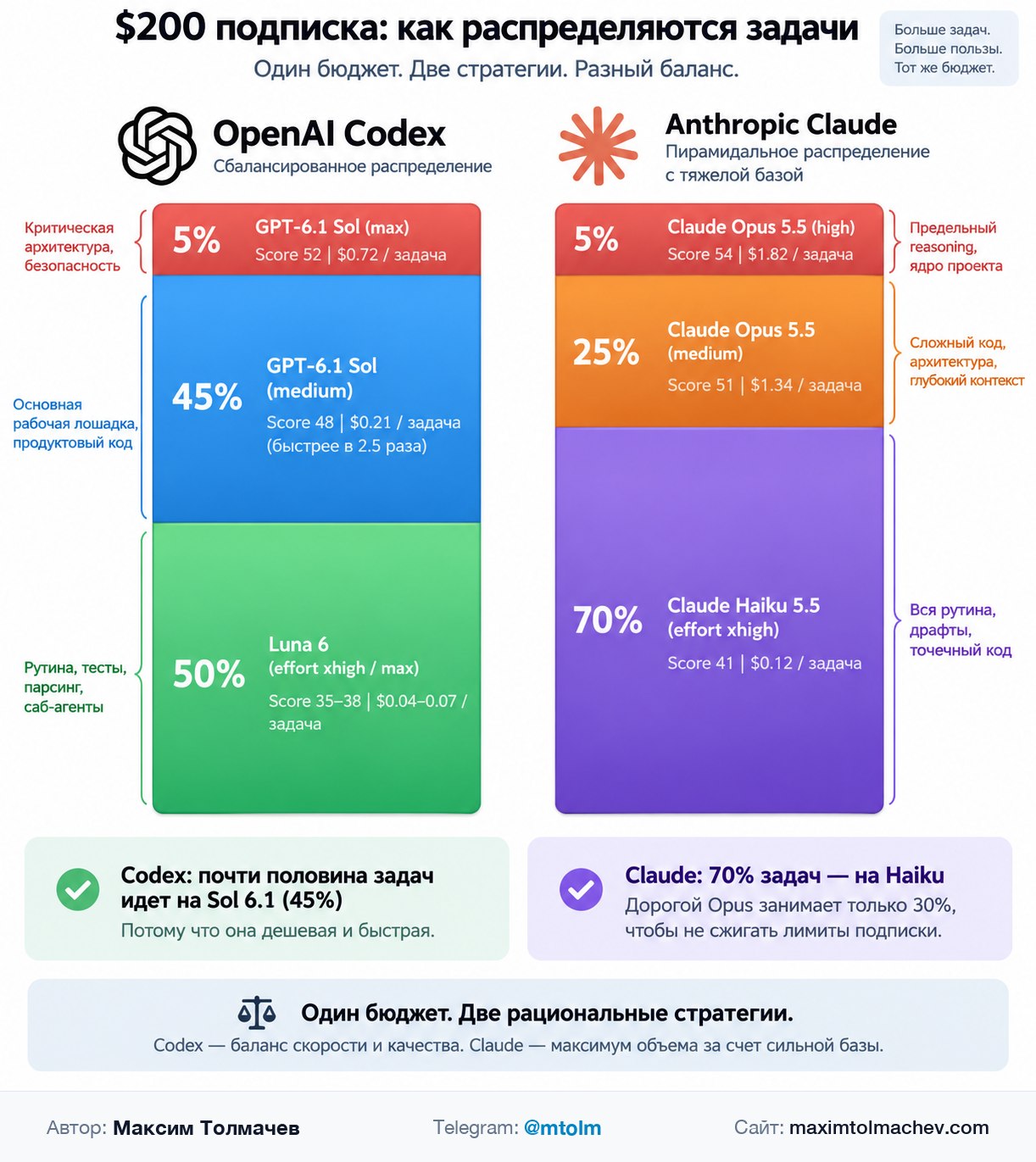
Task allocation atlas: 3 effort levels in Codex and Claude for $200 subscriptions
Based on the latest Artificial Analysis benchmarks in my interactive model economics dashboard, the optimal working setup looks like this:
1️⃣ OpenAI Codex stack
• 50% of tasks — Luna 6 xhigh / max (Score 35–38, $0.04–0.07 per task). Parsing, tests, small scripts, and cheap sub-agents that do the dirty work for the main model.
• 45% of tasks — GPT-6.1 Sol medium (Score 48, $0.21 per task). The main workhorse. In terms of intelligence, it has caught up with yesterday’s top models, while completing a task in 2m 38s versus 6m 29s for Luna max—2.5 times faster at the ridiculously low price of 21 cents.
• 5% of tasks — GPT-6.1 Sol max (Score 52, $0.72 per task). Critical core logic, security, complex math, and deep audits.
👉 Codex workflow result: the average task costs only about $0.16. A $200 subscription comfortably covers more than 1,200 real tasks per month.
2️⃣ Anthropic Claude stack
• 70% of tasks — Claude Haiku 5.5 xhigh (Score 41, $0.12 per task). According to AA benchmarks, this little monster beat Luna max (41 versus 38) and costs only 12 cents. It’s where you should offload all the routine work, document drafts, and targeted codebase edits.
• 25% of tasks — Claude Opus 5.5 medium (Score 51, $1.34 per task). Deep product code, complex multi-file refactoring, and architectural decisions.
• 5% of tasks — Claude Opus 5.5 high (Score 54, $1.82 per task). Maximum reasoning for the trickiest bugs, where every nuance of the logic matters.
👉 Claude workflow result: the average task costs about $0.51, with a high average intelligence score of 44.2.
Why are the ratios different? In Codex, Sol 6.1 is so cheap ($0.21) that it makes sense to keep it enabled for almost half of all tasks. In Claude, Opus costs $1.34–1.82 (6–8 times more than Sol), so Haiku is the workhorse at 70%, while Opus is brought in selectively.
🚫 What I excluded from the pipeline
• Claude Fable 5.1: with comparable intelligence (Score 47–53), a task can cost up to $7.63, plus there’s a cap of up to 50% of the Max plan’s weekly limit.
• GPT-6 Astra: burns through the quota like a sports car ($0.82–3.26 per task) without delivering a quality advantage over Sol 6.1.
You can see the detailed trends and a comparison with the September snapshot in the previous post, or explore all the model data points at maximtolmachev.com/model-economics/.
What effort level do you usually use by default?
В прошлый раз я показывал, почему падение долларового эквивалента в Codex — это не катастрофа, если правильно подбирать модели. Сегодня разберём практический атлас: что включать в Claude и Codex под разные типы задач.
Главный рычаг управления квотой сейчас — параметр effort. Это не волшебный переключатель «сделай лучше», а бюджет времени и токенов на внутреннее рассуждение модели. Если выкрутить его на максимум на простой задаче, модель не станет гениальнее — она просто сожжёт лимиты и заставит вас ждать втрое дольше.
Атлас распределения задач: 3 уровня effort в Codex и Claude для подписок за $200
По свежим замерам Artificial Analysis на моём интерактивном дашборде экономики моделей оптимальная рабочая сетка выглядит так:
1️⃣ Связка для OpenAI Codex
• 50% задач — Luna 6 xhigh / max (Score 35–38, $0.04–0.07 за задачу). Парсинг, тесты, мелкие скрипты и дешёвые саб-агенты, которые делают грязную работу для основной модели.
• 45% задач — GPT-6.1 Sol medium (Score 48, $0.21 за задачу). Главная рабочая лошадка. По интеллекту она догнала вчерашние топ-модели, а по времени решает задачу за 2м 38с против 6м 29с у Luna max — в 2.5 раза быстрее при смешной цене в 21 цент.
• 5% задач — GPT-6.1 Sol max (Score 52, $0.72 за задачу). Критическое ядро, безопасность, сложная математика и глубокий аудит.
👉 Итог потока в Codex: средняя стоимость задачи всего около $0.16. Лимитов подписки за $200 спокойно хватает более чем на 1200 реальных задач в месяц.
2️⃣ Связка для Anthropic Claude
• 70% задач — Claude Haiku 5.5 xhigh (Score 41, $0.12 за задачу). По замерам AA этот маленький монстр обошёл Luna max (41 против 38) и стоит всего 12 центов. На него стоит сгрузить всю рутину, драфты документов и точечные правки в кодовой базе.
• 25% задач — Claude Opus 5.5 medium (Score 51, $1.34 за задачу). Глубокий продуктовый код, сложные многофайловые рефакторинги и архитектурные решения.
• 5% задач — Claude Opus 5.5 high (Score 54, $1.82 за задачу). Предельный reasoning для самых запутанных багов, где важен каждый нюанс логики.
👉 Итог потока в Claude: средняя стоимость задачи около $0.51 при высоком среднем интеллекте (44.2 балла).
Почему пропорции разные? В Codex Sol 6.1 настолько дешёвая ($0.21), что её выгодно держать включённой почти на половине задач. В Claude Opus стоит $1.34–1.82 (в 6–8 раз дороже Sol), поэтому рабочая лошадка здесь — Haiku на 70%, а Opus подключается точечно.
🚫 Что я исключил из пайплайна
• Claude Fable 5.1: при сопоставимом интеллекте (Score 47–53) задача обходится до $7.63, плюс действует ограничение до 50% недельного лимита плана Max.
• GPT-6 Astra: съедает квоту со скоростью спорткара ($0.82–3.26 за задачу), не давая отрыва в качестве от Sol 6.1.
Подробную динамику и сравнение с сентябрьским срезом можно посмотреть в предыдущем посте, а покликать все точки моделей — на maximtolmachev.com/model-economics/.
Какой effort обычно стоит у вас по дефолту?